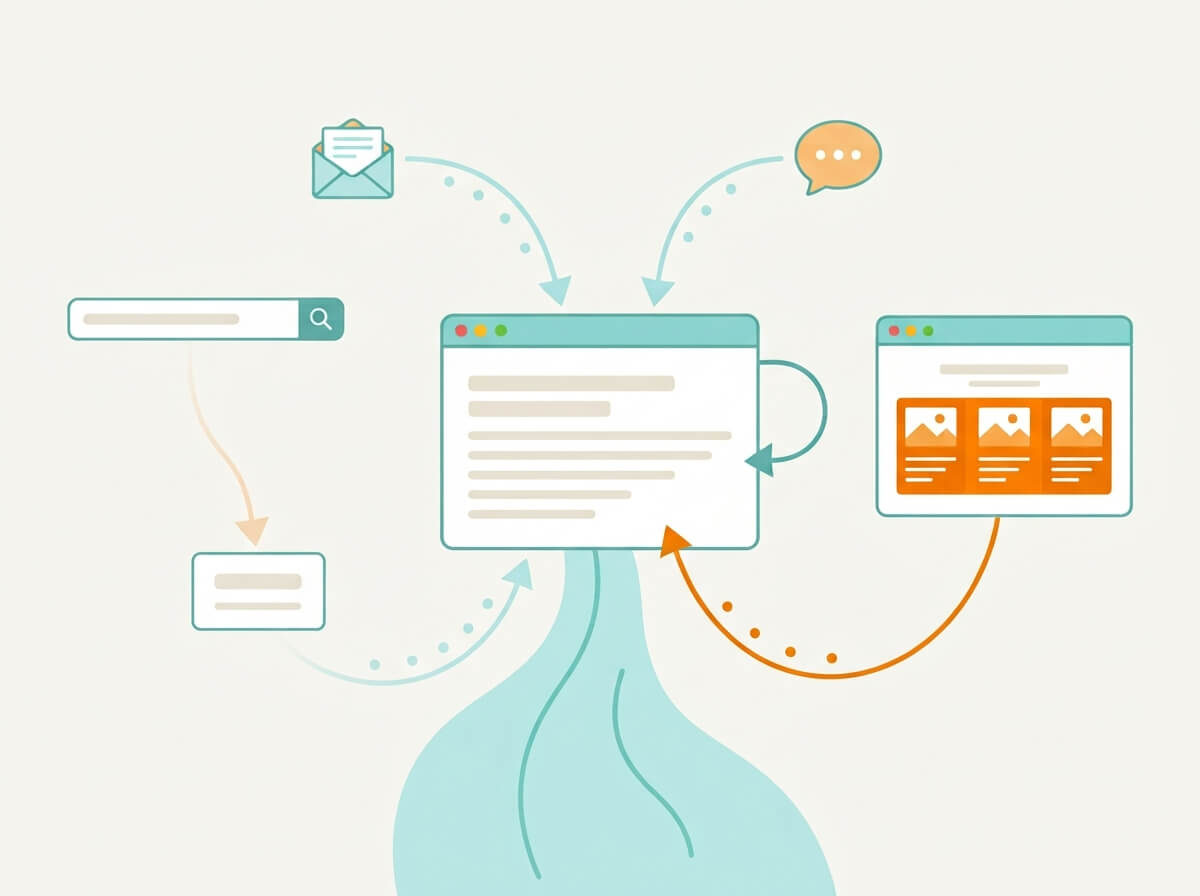
Search used to be the one channel a blog could count on. You wrote a useful post, it ranked, and readers kept arriving for years. That deal is changing: more questions are answered right on the results page, and fewer people click through. If you want to increase blog traffic without Google carrying all of the weight, the answer is not one magic channel but a few smaller ones you build on purpose – and that keep working whatever the next search update does.
This article looks at what the numbers actually say, why small sites feel it first, and which sources of referral traffic are worth your time now.
What changed in search – and who feels it most
Since Google rolled out AI Overviews in 2024 and followed with AI Mode, a growing share of searches end with an answer instead of a click. Publishers have seen it in their analytics, but the size of the drop depends a lot on who is measuring and whose sites they track.
One of the clearest datasets comes from Chartbeat, which measures traffic across a large network of media sites. Its 2026 report, Navigating the New Traffic Landscape, found that:
- pageviews from Google Search fell 34% from December 2024 to December 2025, and pageviews from Google Discover fell 16%;
- overall pageviews dropped by about 6% year over year – a decline, but not a collapse, because most other channels held steady;
- AI chatbots, despite fast growth, still brought less than 1% of pageviews.
So search is not disappearing. It is shrinking as a share of how readers arrive, and the clicks it lost are not coming back through chatbots.
Why small blogs are hit hardest
The same report split the search decline by site size, and the gap is striking. Small publishers, with 1,000-10,000 daily pageviews, saw search traffic fall 60% year over year. Medium sites lost 47%, large sites 22%.
Chartbeat's own reading is that brand recognition and direct relationships have become survival tools. A large site has readers who type its name or open its newsletter. A small blog often has only search: readers who found one post, read it and never learned the name of the site. When the results page answers the question itself, that reader does not arrive at all.
Chartbeat's network is mostly news and media sites, so your own numbers may look different. The logic, though, applies to any site that lives on search: the less a site is known by name, the more it loses when search keeps the click.
Keep the basics: search is a channel, not the whole plan
None of this means giving up on SEO. For most content sites, search is still one of the largest sources of visits, and a well-structured, genuinely useful article still ranks. The same report notes that AI referrals favor practical, evergreen content – how-to guides, explainers and references where a reader can dig deeper.
What changes is the plan around it. Treat search as one source among several. Write the kind of post a short answer cannot replace – first-hand experience, depth, a clear point of view. And start building the channels below while search is still paying the bills.
How to increase blog traffic without Google
The channels that grew while search fell have one thing in common: they rely on readers rather than on an algorithm deciding to show you.
Bring readers back directly
A newsletter is the most direct relationship a blog can have. A reader who subscribed does not need to find you again – you arrive in their inbox. Even a simple digest of new posts turns one-time visitors into returning ones. Put the sign-up at the end of articles, where a satisfied reader decides what to do next.
Keep the readers you already have
Chartbeat found internal traffic – visits that come from another page on the same site – rising from about 38% of pageviews in 2024 to about 41% since November 2025. It is the channel you control most. Link related posts inside your articles, add a related-posts list, and build topic pages that gather your best work on one subject.
Make posts easy to pass on
Dark social – visits that arrive without referrer data, typically from messaging apps and email – grew from about 7% of traffic in 2024 to 10% in January 2026 across Chartbeat's network. You cannot see who shared a link in a group chat, but you can make it likelier: headlines that make sense out of context, and share buttons that work well on a phone.
Reach other publishers' audiences
The hardest problem for a small blog is not keeping readers but getting in front of new ones. Guest posts, communities and podcasts all help, but each placement takes fresh work. Recommending each other's content scales better: a reader who finishes an article on one site sees a few headlines from related sites, on every page view, with no new work each time.
Where a content traffic exchange fits
This is the idea behind Traffman, a content traffic exchange network for publishers. Instead of buying visitors, participating sites show each other's articles:
- Your site hosts a recommendation block with articles from other members of the network.
- Your own articles appear in blocks on their sites, and their readers come to you.
- You choose which posts take part. Nothing is shared without your explicit action.
- You decide what may appear on your site – by language and topic, with blacklists of words and domains you never want to see.
The exchange is kept balanced with points. Displays and clicks of the block on your site earn them; displays and clicks of your content elsewhere spend them. A site that only takes and never shows runs out of balance, which is what keeps the exchange fair – see what the content block does. Views and clicks that look inflated, from a script or a hidden block, neither earn nor cost anything.
Two more things are worth knowing before you add any widget to your pages. First, search: the Traffman block is rendered by JavaScript in the visitor's browser, and the HTML your server sends holds only an empty container, with no borrowed text and no links to other sites – so it does not affect how your pages are indexed. Second, trust: give the block a clear heading such as “From other publishers”, so readers know the links lead to other sites.
A complement to search, not a replacement
Be realistic about what an exchange does. It will not replace search for a site that gets most of its visits from Google, and it will not make thin content perform. What it adds is a steady source of referral traffic that does not depend on any ranking: readers who were already reading on a related site and chose to open your headline.
Because those readers land on an article – exactly what the headline promised – they arrive ready to read. That is why native content recommendations hold attention where banner ads lose it, as described in why banner blindness is killing your ads. And since Traffman is a young network, what it brings grows with the number of members writing in your language and on your topics.
Measure each new channel honestly
A new source of traffic is only worth keeping if it brings readers, not just numbers. A few habits help:
- Watch engagement, not only visits. Compare time on page and pages per visit by source in your analytics. A small channel with engaged readers can be worth more than a large one with instant bounces.
- Separate seeing from clicking. For recommendation blocks, a load is not a view: a block at the bottom of a page nobody scrolls to is never seen. Traffman's statistics show loads, views, clicks and CTR separately, both for the blocks on your site and for your content on other sites.
- Give it time. Newsletters grow slowly, and an exchange settles as you tune targeting and pick the posts to share. Judge a channel after weeks, not days.
- Adjust what you share. Swap out posts that get views but no clicks – often the headline or the image is the problem, not the topic.
The bottom line
Search is not dead, but it no longer guarantees that a useful post finds its readers. Small blogs feel that first, because they have the fewest readers who know them by name. The way forward is to build several channels you do not have to win back with every update: readers who subscribe, readers who stay for a second article, readers who share, and readers who reach you from related sites.
A content traffic exchange is one of those channels – something you add next to search, not instead of it. If your blog runs on WordPress, read how Traffman works and see whether it fits. The plugin's demo mode lets you see the block on your pages before anything is exchanged for real.